
Harnessing Hallucinations
Human Agency and AI Agents

When Andrej Karpathy speaks about AI, I stop what I’m doing and listen.
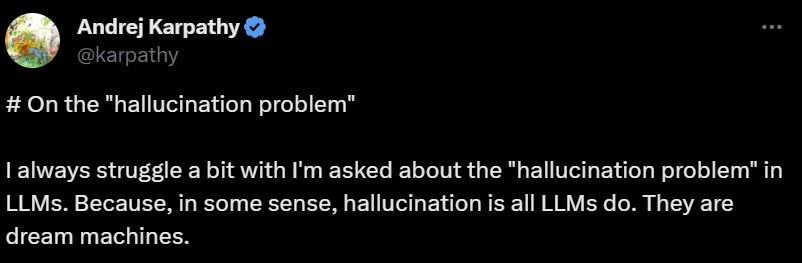
The concept of AI hallucination, or dreaming, sets Large Language Models (LLMs) apart and is precisely why entrepreneurs in the AI space are buzzing. They’re exploring one fundamental question: “What can you do with a computer that makes stuff up?”
For any corporation, this dreaming function of AI can open up many possibilities. The applications are vast and transformative, from chatbots enhancing customer interactions to AI co-pilots during risk assessment. The most impactful of these applications must harness AI’s creative potential and effectively control and direct the outcomes. This sounds like a familiar challenge.
The history of trade and organizing an economy details the double-edged sword of human creativity – its potential for groundbreaking innovation and unpredictable risk. Like humans, AI can “dream” up new solutions and ideas, but these need to be harnessed and directed through governance and control mechanisms.
Consider the emerging use of AI Agents – distinct chatbots programmed for specific tasks, working in unison. This chaining of chatbots is trying to unleash and harness AI’s creative capacity. The strategy is about striking the right balance: empowering AI to generate non-deterministically yet keeping these solutions aligned with practical and specific objectives.
By harnessing AI’s hallucinations, we can emulate the dynamism of human thought without the agency of human action. It opens up a “policy is code” era for corporate governance, where low-agency and high-compliance tasks are delegated and enforced by AI systems. At the same time, human agency, energy, and creativity are focused on remaining intelligent. In the specific areas of audit, compliance, and governance, to name a few, this translates to AI-driven systems ensuring high accuracy and consistency against published frameworks, managing vast data sets, and evidencing compliance more efficiently than we ever could.
This dual approach, where AI handles the systematic and low-agency tasks while humans address the uniquely human challenges, sets the stage for a transformative shift in organizing corporations, enhancing both the execution of routine tasks and the quality of complex decision-making.
Harnessing AI hallucinations is not futuristic; it’s the coming reality for efficient economic competition. As we stand at this exciting junction, the question for every professional is not just about adopting AI but about creatively integrating these “dream machines” to amplify our execution and risk management.
Here is a fun glimpse into this near-term reality: ChatDev